Wednesday, April 30, 2014

My funding wars

So, on a more personal note, I'd like to blog this month about the struggle that is funding for me this semester.
It began in February, unable to get in touch with my organization in Senegal in time to get my ishh together to apply for the GPP Fellowship, and not realizing I could submit it incomplete, I dug myself into a pretty deep hole. The walls seemed vertical at times, anxiety and stress kicked in as I began to tear up as I wondered if I could even continue on my original plan to go to Senegal this summer and work with urban farmers and their organization, Provania.

However dark this hole appeared to me at moments, I actually see it as a great, super harsh, but super effective learning lesson. After my mistake with the GPP Fellowship, I have found out about the Summer Undergraduate Research Fellowship... two days before the deadline. Thank goodness for the literature review, because it helped me a lot in writing my research proposal - my plan, the context and existing background information or debates, and its impact potential or place in this great world/sector/area. Not to mention it gave me a bit of credit as a applicant to already be in the process of researching and writing a literature under the guidance of Lauren, our GSI, and Clare Talwaker, a notable name on campus. After scrounging together everything I needed for applying for a fellowship (first timer), such as my transcript, major verification, the proposal, a loose budget, my qualifications, contacts, etc., and a very kind Faculty Adviser, I submitted my application. & I am very grateful to be able to say that I received it!... AND they'd give me an opportunity to introduce human subject into my research (interviews, and I had applied for the non-human subjects fellowship because of a the deadline)!

... And then, I met eProtocol. My newest super galactic obstacle course. I completely understand that research involving human subjects should go through an intense board review, so I don't wish to talk down the process or its necessity at all, but I do wish to warn you all. If y'all are planning on being a main investigator, or are for some other reason in charge of filling eProtocol to Berkeley's Review Board, I highly suggest going to a workshop or talking to someone, because that thing is TEDIOUS. At times, the questions are simple, and the answers are easy, but there's just so many! With CITI training, it literally took me two weeks in between regular school assignments. At times I just wanted to ... not be nice to the computer. Being prepared for that would have really helped a girl out, here. It's funny because right after I submitted it, Chetan sent out  this announcement:

DIL Workshop: IRB Approval Process
Date: May 7, 2014
Time: 1:30pm-2:30pm
Location: Blum Hall, Room 200G
Learn about the IRB Process and how to get approval for research that includes human subjects. 

I HIGHLY SUGGEST YOU GO! 

I'm currently on the editing process, replying to comments of my reader, and am looking forward to also feeling very proud about finishing the eProtocol lesson, and gaining those skills.

Finally, my journey has come to Indiegogo. Writing my own campaign (made easy after writing the literature review and the proposal, now) and officially asking my friends, family, strangers, and all affiliated networks for money for my first time, also. I have to say, although it's not as formal or fancy as GPP or Fellowship applications, doing this has also taught me valuable things: to get over that awkward social thing of asking for money (because I'm not just asking for nothing, I believe in what I'm doing, so I just need to own it), and to learn how to change my academic jibberish into real English for all sort of peoples from all sorts of backgrounds to understand and want to support. It's kind of like I'm doing my own PR and outreach. & At the same time, I get to spread the word about urban agriculture, about food, about research, and about what I think about those things. 
You can find my Indiegogo at:
 igg.me/at/asiagoestoafrica


It's been a struggle, it's been real, it's been a pleasure. I hope you all are set, and ready to go with money. And I hope it wasn't a struggle, but if you're in the same as I am, I just want to say that I think we're stronger now, and that it was a good journey. We can do it!!!!!!!!!!!!!!!!!

Peace <3 Asia

Half The Sky...Do we celebrities to tell us about the injustices of poverty?

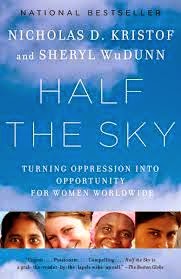
In 2009, husband and wife team, Nicolas Kristoff and Sheryl Wuudon published ‘Half the Sky’ a novel addressing pressing women’s rights issues ranging from sexual violence, sex trafficking, maternal mortality, girls’ education to economic empowerment. I saw the film adaptation of this book last year.

Take a look at this excerpt from a segment about sex trafficking in Cambodia. What do you think of it? http://www.youtube.com/watch?v=2LZheCJXjco


A reoccurring theme in ‘Half the Sky’ is celebrities traveling to distant parts of the world to account their powerful encounters with poverty and their witness to injustices relating to women’s rights.  In this excerpt, Meg Ryan briefly describes her experience in Cambodia, very much reinforcing the “gaze’ of the tourist. Although I believe in this film’s message and enjoyed parts of it, this quality turned me off. Why do we need to hear about the horrors of trafficking by a celebrity? So we can relate to them more, as a Westerner encountering the developed world, or to attract more public attention for the film? I personally don’t find this directing choice necessary. In this clip, Ryan praises Kristoff for his efforts against trafficking, but I don’t think that this film should be focusing on him at all, but simply the issue itself. It made me feel that the film was partially produced to boost Kristoff’s reputation as an advocate for women’s rights, rather than simply let the women tell their stories. What do you think? 


Tuesday, April 29, 2014

Does Global Warming Cause Violence? Ted Miguel at TEDxBerkeley


Professor Ted Miguel notes that Africa is growing economically, and it will be a major contributor in the global economy in the upcoming years. Yet, it is one of the most unstable regions in the world, plagued by corruption, civil war, and unstable governments. Miguel found that this instability and violence is likely to worse the situation, and Sub-Saharan Africa will see some of the highest social impacts of global warming.

As dire as this situation seems, is this violence and increased conflict inevitable? Is it possible to take steps prevent these acts from happening? Furthermore, is global warming going to become an excuse for our actions i.e., "I couldn't help it--the heat caused me to act violently." It is imperative that we look at the costs of development and convenience through a social, as well as environmental, lens.

Mass Incarceration in the United States


"Being tough on crimes (is not the same thing!) as being tough on criminals"

This video illuminates the problem of mass incarceration in the United States. The war on drugs and tough on crime policies and ideology have resulted in the surge of the incarceration rates in the United States. Over the past three decades, the number of prison inmates in the United States has increased by more than 600 percent. I have even read Michelle Alexander's great book arguing that this phenomenon is the "New Jim Crow" in the age of colorblindness. On my end, I am more interested in the post-incarceration policy to mitigate such complex problem: such as the "ban the box" movement which is gaining support. One notable organization at the forefront of this is “All of Us or None,” a nonprofit grassroots organization based in Oakland that is dedicated to eliminating discrimination against ex-offenders, and has propelled the Ban the Box campaign nationwide. Currently, 50 cities and counties and 10 states have taken the important step of removing unfair barriers to employment in their hiring policies. Adopting the policy widely known as “ban the box,” these initiatives typically remove the question on the job application about an individual’s conviction history and delay the background check inquiry until later in the hiring process. Of those ten states, four states—Hawaii, Massachusetts, Minnesota, and Rhode Island—have banned the box for private employers, which many advocates embrace as the next step in the evolution of these policies. These initiatives are due to the prevalent discrimination practices towards ex-offenders in job applications. Positive outcomes have been shown and better outcomes are anticipated from this ban-the-box movement such as lower recidivism and giving equal chance to ex-offenders to reintegrate into society. Although there are more rooms for advocacy with regards to the lives of ex-offenders such as housing, education and welfare discrimination, - the focus on employment will substantially propel more reform to come, I hope. As Michelle Alexander sarcastically notes in, “[a]fter all, criminals are the one social group in America that nearly everyone – across political, racial and class boundaries – feels free to hate.” Through discriminatory practice, it made me reflect upon this occurrence: that we “boxed” in the lives of ex-offenders with endless suffering; perhaps we should analyze who are really impersonating the role of “offenders”.


Poverty in the United States

"Poverty in America: Why Can't We End It?"

This article begins with a quote from Ronald Reagan "We fought a War on Poverty and Poverty Won".  The United States a wealthy country that does not suffer from the infrastructural lackings of many countries in the global south still reproduces a society with poverty. I have often heard the bafflement from the poor in other countries as they consider the possibility of there being poverty in a country that is supposed to be the land of opportunity. Although this article does not provide for an answer to why there are poor amongst our midst it does stop the romanticization of poverty as something far away. Additionally it stops the misconception that through development all poverty will alleviated.

"The Harlem Miracle"


"The Harlem Miracle"


This New York Times article by Brooks is about the Harlem School Zone, an educational program in New York City that transformed the lives of low-income children by addressing their specific needs through an understanding of the disenfranchised communities the children came from. The article additionally, yet seemingly unintentionally, depicts the increasing cost of gaining a higher education and the way that the university is again becoming an institution of the elite instead of a tool in upward mobility within the United States. Institutions of higher learning do not meet the needs of the low-income student and without programs like the Harlem School Zone the low-income student is not properly equipped with the institutional savvy to to navigate the university. However the problem goes beyond education; the reproduction of class status within our society is an issue that must be addressed at the institutional level in order to bring about true longstanding change. 
 
The use of education as a poverty alleviation tool depicts how reformers like Brooks believe that widespread institutional level programs are not necessary to achieve goals in societal transformation. After having read the piece by Katz I see that the Harlem School Zone program stops at the People level of poverty alleviation. Brooks as well as the Harlem School Zone program assumes that the success of the students is in large part due to the inculcation of "middle-class values" to the poor students. This postulation places poverty as a problem of the individual and consequently there is no addressing of how the miracle of Harlem can be incorporated to the entire nation.

Leslie Dodson's TEDxBOULDER talk: relate to discussion on visual documentation


This talk reminded me about our discussion on visual
documentation and how they tend to intensify suffering, generalize suffering,
and “present subjects as passive and viewers as comparatively active.” These are
actually evident when the speaker showed pictures of “the utterly distressed
[…] the displaced, [and] the hungry.” These are indeed real ethical dilemmas
surrounding the ways in which poverty is portrayed in media and or in research.
While these issues are serious, I personally find it hard to deny the fact that
somehow there is also good that we can get out of them. For one it raises
awareness and educates other people who may have never neither encountered nor heard
about poverty in X country. And while yes they might be limited to a single
snapshot or 2D image that the photographer thought was “the” representation of
poverty but it is still something, in fact maybe that was what it all takes to
spark motivation for poverty (or any kind of) action.

Nonetheless, I am still left asking what then IS the right
way to depict poverty so that it is not intensifying/romanticizing it, or
generalizing, or present subjects as passive (and viewers active)? Is it even
possible?


Thoughts?

Monday, April 28, 2014

I Will Travel to Bolivia at a Historic Time this Summer

     I will be entering Bolivia at a very interesting time. For the first time since the establishment of the country, an indigenous president was elected democratically. Bolivia has seen much progress since it revolution in 1952. Evo Morales is a fascinating president who has given cocaleros, coca leaf growers, a great deal of autonomy despite pleas from the United States and the Drug Enforcement Agency.
     The coca industry is not only illegal, but it is also larger than any legal industry in the country. At one point, a jailed coca baron offered all of his profits to pay off the country's debt for his release. Although this never happened, it clearly illustrates the billions of dollars that flow through this black market. Here is a long video that discusses Morales's political party and his plans for the future. Skip to 18:00 to watch what has happened as of recent to the cocalero movement.
     As I enter Cochabamba, Bolivia, I will be experiencing blockades and tear gas on a regular basis. I can't be more excited!


Preparing for College in Kindergarten

          A New York primary school recently canceled an end-of-the-year play for kindergarteners. The reason? The teachers and administration “are responsible for preparing children for college and career with valuable lifelong skills and know that we can best do that by having them become strong readers, writers, coworkers and problem solvers,” according to a signed letter sent out to the parents. Basically, the school felt that the putting on a play was not an effective use of the kindergarteners’ limited studying time.
Although I personally find this premise ridiculous, I assume the parents enrolled their kids in this school with knowledge of just how seriously it took college readiness. If the parents dislike it, they can switch their kids to other schools. But there is a more serious underlying issue here – as the wealthy start preparing their kids for college in kindergarten, students in less intense schools will fall further behind in their competiveness. Students who have been trained to write college application essays from the age of five will undoubtedly be at an advantage. And since a college diploma is one of the biggest determinants of a well-paying career and success in this country, a vicious cycle will be propagated. The rich will get richer as they become even more advantaged in the college admissions process, while low-income students will struggle or be trapped, unable to get acceptance letters from the top universities.
Canceling a kindergarten play may seem like a minor event, but I think it speaks to larger issues of educational inequality in the United States. I don’t know what the best course of action is, but I know that the current trend is unfair and, quite frankly, makes no one happy. Regardless of background or aspirations, kindergarten should be a time of finger painting and picture books, not standardized tests and studying.


The Effect of Climate Change on Climate Conflict

Climate, conflict, and African development: Edward Miguel at TEDxBerkeley

The world--most of its educated population, at least--seems to be relatively aware of the geological and environmental implications of rising temperatures. In his Ted Talk, our very own UC Berkeley adds another dimension to the discussion: increased violence and conflict, a detriment that is often overlooked. He reveals studies that predict that a mere 2 degree increase that is meant to take place by 2050 will increase violent conflicts by up to 40%.

Narrowing in on development in Africa, Miguel discusses the economic turn that the continent is taking: slowly, but surely, in the last 15 years Africa has seen increased economic growth, incomes, and population. This turn could potentially go bleak with rising temperatures, and consequently, increased conflict in a region that already faces considerable violence and corruption.

He claims that while the 2 degree increase in temperature will have negative effects worldwide, these effects will be especially present in Africa. This is largely because African economies rely extensively on agriculture, and because there is

African economies rely extensively on agriculture, where the majority of the population still work as farmers. Further, African farmers typically don't have irrigation, relying instead of rain-fed agriculture. Therefore, when rains fail, crops fail, and incomes plummet. In the event of a drought and dropping economic activity, government resources and services dwindle and sadly, it is all too common for militias and opposition groups to step in.

Will this become a hindrance to Africa's recent economic turnaround?

According to Miguel and the studies he uses to evidence this assertion, the answer is a resounding yes.

80% of African countries have suffered from armed conflict for at least a single year, though much more commonly, they last for years, and sometimes, decades. The result is the wrecking of society: incomes drop (eg: In Sierra Leone, average incomes fell by 40% during its civil war from 1991 to 2002), thousands to millions are displaced, injured, or killed.

If global warming were to take place, temperatures rise, and violence arises, armed conflicts such as that which devastated countries like Sierra Leone will become and more prevalent, hindering the progress that Africa has been making in the past ten or so years.

If this is the case, what can the world do in response? What can Africa do in response?

Miguel's answer: "A worldwide research effort is already underway, getting started to try to solve these problems. How can we do that? Some scientists are developing new crops that are resistant to extreme climate. Others are trying to figure out how we can introduce insurance schemes--maybe weather insurance schemes--to help African farmers adapt to climate change. But the truth is: we don't know the answer. We're trying to find out the answers ... Of course the best solution would be not to have global warming in the first place; the best solution would be to reduce emissions enough, so the world doesn't warm by two or three or four degrees Celsius in the next few decades."

Climate change is not Africa's fault, and Africa should not have to pay an excessive and excruciating price for the global warming.